

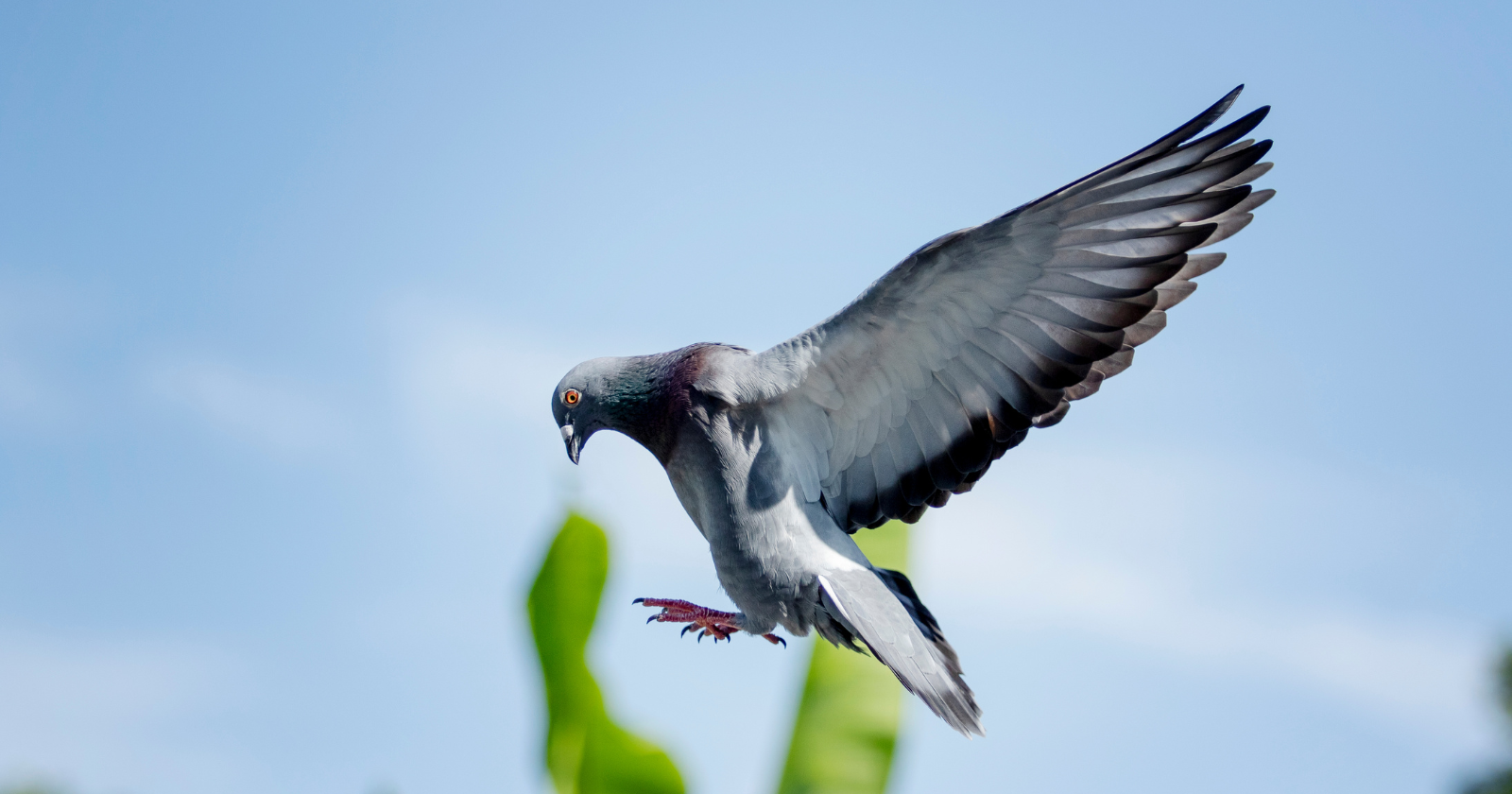
A pigeon that loses the sun does not necessarily lose its way home.
According to a study published in Science on 28 May 2026, homing pigeons appear to fall back on a magnetic sense seated not in the brain or the beak, as earlier research proposed, but in clusters of iron-rich immune cells in the liver, and that sense seems to matter specifically when the sky is overcast.
The paper, “Homing pigeon navigation relies on superparamagnetic macrophages under overcast conditions,” was led by Clivia Lisowski at the University of Bonn and University Hospital Bonn, with senior authors Christian Kurts, an immunologist at University Hospital Bonn’s Institute of Molecular Medicine and Experimental Immunology, and Martin Wikelski of the Max Planck Institute of Animal Behaviour in Konstanz, along with physicist Ulf Wiedwald at the University of Duisburg-Essen.
What the team actually did
The version of this discovery circulating in casual retelling, that blood samples kept mysteriously sticking to laboratory magnets for years before anyone traced the cause, does not match the published account. The search was deliberate. Researchers already knew that the liver and spleen accumulate iron as a byproduct of breaking down old red blood cells, and they used vibrating sample magnetometry and standard magnetic cell-sorting equipment to systematically test which pigeon organs carried a magnetic signal worth investigating further.
The liver’s signal was the strongest of any tissue tested. Closer examination found the iron concentrated in superparamagnetic macrophages, immune cells whose ordinary job is clearing spent red blood cells from circulation, clustered near nerve endings within the organ. Kurts has said plainly that this was not the expected result: “We didn’t expect immune cells to act like sensors for magnetic fields at all.”
Why the cloudy-day detail matters
The experiment that makes the finding interesting, and not simply a curiosity about liver tissue, involved depleting these macrophages in birds trained to home from distances beyond 20 kilometres, then releasing them. On sunny days, the treated pigeons navigated home much as untreated birds did. On overcast days, with the sun obscured, they lost their sense of direction.
That pattern is the paper’s central claim: the liver appears to act as a specific fallback sense, kicking in when the sun is obscured and other orientation cues, however pigeons ordinarily use them, become unavailable. Lisowski has described the result as “the first concrete evidence of how the Earth’s magnetic field can be perceived within the body and passed on to the brain to guide movement.” That is a claim about mechanism and pathway, not a claim that this is the only way pigeons find their way home.
Magnetic sensing of some kind has been proposed in a wide range of migratory animals, including sea turtles, salmon and several songbird species, usually inferred from behaviour rather than located in a specific tissue. Pigeons have been studied more intensively than most, partly because they are easy to breed and release under controlled conditions, and partly because homing behaviour gives researchers a clean, repeatable test: release a bird somewhere unfamiliar and see whether it heads home. That history of study is also why the liver result lands as it does. Researchers already assumed pigeons had more than one way of finding north, and had been looking for a body-based candidate for years.
An older, contradictory chapter in this story
Anyone who has followed pigeon magnetoreception research for a while will recognise a pattern repeating here. In 2012, a team led by David Keays, then at the Research Institute of Molecular Pathology in Vienna, published a paper in Nature showing that iron-rich cells in the upper beak of pigeons, long proposed as the birds’ magnetic sensors, were in fact macrophages, not magnetosensitive neurons. That paper argued the iron in those cells responded too weakly to Earth’s field strength to function as a real sensor, effectively closing the door on the beak as the seat of magnetoreception.
The new liver findings involve the same broad category of cell, an iron-carrying immune cell, but a different organ and the opposite conclusion: here, the iron looks functionally significant, not a red herring. It is a useful reminder that “iron-rich cells found in a bird” is not, on its own, evidence of anything. What matters is whether depleting those specific cells changes behaviour in a specific, testable way, which is what this study set out to check.
Not everyone is convinced
The result has drawn public scepticism from researchers outside the study. Caltech geobiologist Joseph Kirschvink, a long-standing figure in magnetoreception research, has said he was surprised the paper cleared peer review, calling the proposed mechanism implausible on physical grounds. Neuroscientist Pascal Malkemper has pointed out that the evidence linking macrophage depletion to navigation failure is correlational, and that the paper does not establish a causal pathway from liver cell to brain to steering behaviour.
That does not mean the finding is wrong. It means this is one study, using one depletion method, on one population of pigeons, and it has not yet been replicated by an independent laboratory. Magnetoreception research has a history of results that looked solid on first publication and did not hold up, which is exactly why the beak story above is worth remembering here.
What the study does not show
The paper does not claim to have found pigeons’ only magnetic sense, or even their primary one. Much existing research on bird magnetoreception has focused on light-dependent mechanisms involving proteins called cryptochromes in the retina, a proposed pathway that operates through vision rather than iron chemistry and is a separate line of research from this one. The liver macrophage finding, if it holds up, looks more like a backup system that becomes relevant precisely when solar and visual cues are degraded by cloud cover, not a replacement for everything scientists already thought they understood about how pigeons navigate.